Twelve roles become three: what Gartner's team shapes mean for provability
2 min read
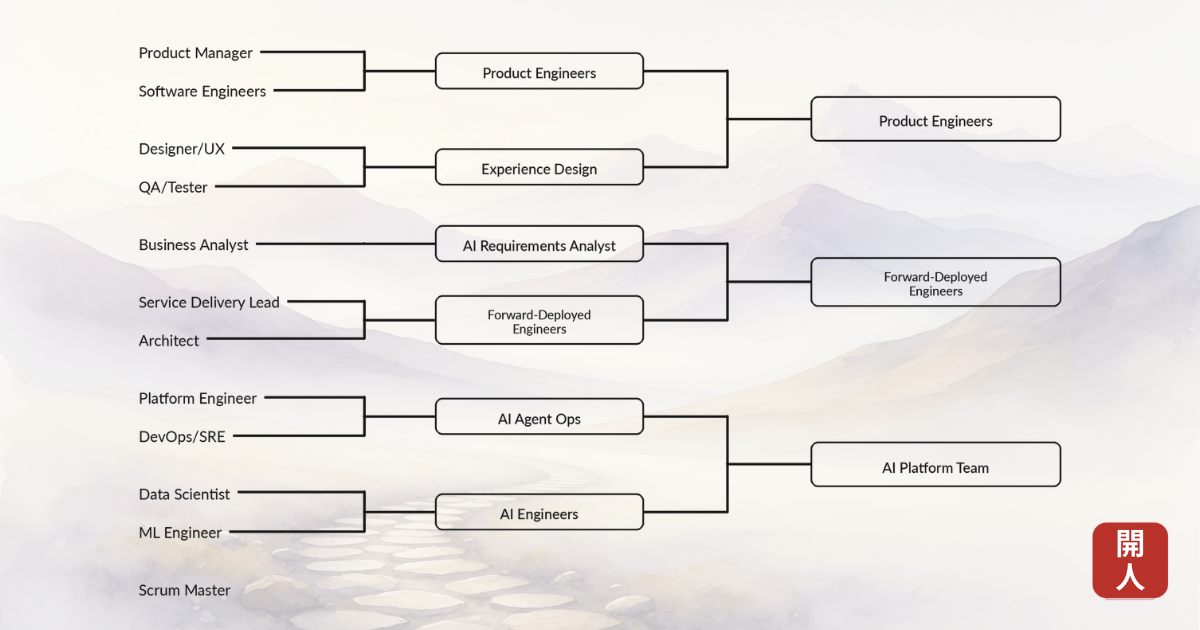
What Gartner says
Gartner expects that by 2029 a large share of organisations will run with noticeably smaller software engineering teams (press release, July 2026). More interesting than the prediction is the role map shown alongside it.
About a dozen of today's roles — product manager, software engineer, designer/UX, QA, scrum master, business analyst, service delivery lead, architect, platform engineer, DevOps/SRE, data scientist, ML engineer — collapse into three team shapes:
- Product engineers — product, delivery and experience in one place.
- Forward-deployed engineers — close to the customer, between requirement and system.
- AI platform team — agent ops, AI engineering and the platform underneath.
What it actually says
This is not a statement about headcount cost. It is a statement about handovers. The roles that disappear are mostly translation roles: between domain and delivery, between delivery and operations, between requirement and sign-off. A team that decides more for itself needs fewer people passing decisions along.
Why that is not automatically better
Every handover used to produce an artefact. A ticket, an acceptance record, a specification, an approval. Not because anyone wanted documentation, but because two roles had to agree. Remove the handover and the artefact quietly goes with it — and the decision stays in the head of whoever made it.
That is exactly what hurts two years later: in an audit, in a customer dispute, when someone asks why an approval looked the way it did. Fewer roles therefore does not mean less evidence. It means the evidence has to live in the system rather than in processes between people.
Three practical consequences
- Decisions belong in the system. With no role whose job was to record them, the application itself has to capture what was decided, by whom and on what basis. Domain events instead of later reconstruction.
- Forward-deployed is not a support function. The role only works if it means proximity to the business rather than ticket intake with a better title. Otherwise it is the old translation layer under a new name.
- The AI platform team is an operations function. Agents producing code or decisions need the same accountability as people: provenance of the change, limits of autonomy, an auditable trail. See Production readiness in the AI factory.
What this does not answer
A new team shape does not create responsibility. In organisations where nobody owns a system end to end today, consolidation only puts the same ambiguity on fewer shoulders. If the open question is who is accountable after go-live, start here: Ownership instead of roles.
Which evidence a team cut this way has to produce during an audit is set out in the provability overview. Where roles and permissions get checked in practice is covered in tenant separation in the security questionnaire.
← Back to the blogArticles on this topic
Compliance & provabilityField notes
CRA reporting duty: what your system must deliver within 24 hours
Since 11 September 2026 the Cyber Resilience Act reporting deadlines apply. What the notification requires — and why scattered logs eat the 24 hours.
Compliance & provabilityFoundation
Tenant separation that survives the security questionnaire
One forgotten filter is a reportable incident. Why isolation in application code is not evidence — and which models enterprise buyers accept.
Compliance & provabilityField notes
Tamper-proof logging: why database logs do not count in an audit
Almost every system logs. Audits still fail on the question of who changed what and when. The difference between a log and evidence — and what creates it.